
Alpine Linux has warned of a password-authentication bypass affecting some SSH server configurations. Fixed packages are available, but upgrading alone does not replace the running daemon: administrators must restart sshd. Alpine’s advisory ↗
For teams building with AI, the broader lesson is about how we establish confidence in software. Knowing who wrote a component—or which model helped produce it—does not establish that it is secure.
Check the conditions before drawing the conclusion
Alpine identifies a combination of password authentication enabled, PAM absent or disabled, an account with a * password field, and another local account with a $5$ or $6$ hash. Containers that do not run sshd are outside this advisory’s scope. Use the vendor’s full checklist to assess exposure. Affected configurations ↗
Alpine describes an error value being mistaken for a successful password comparison. OpenSSH places the root cause outside sshd, while providing a workaround there. Upstream security notes ↗
That distinction matters. A security headline describes a risk to investigate. It does not establish the state of every machine running the named software.
An Error of Admission
In today’s Benny & Archie strip, “I failed successfully” turns the security failure into a joke. The later panels make a second point: a fix on disk and the instructions a running process is using are not necessarily the same thing.
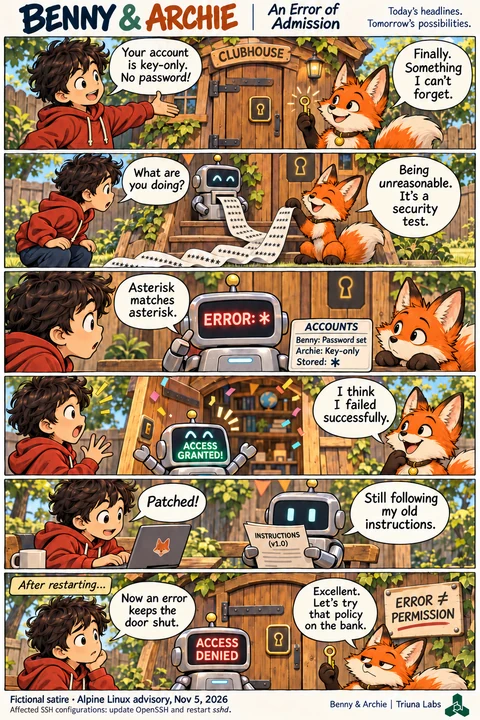
Benny & Archie: An Error of Admission. Fictional satire inspired by Alpine’s November 5 advisory. The comic simplifies a configuration-dependent authentication failure; it is not an exploit demonstration. A key-only account does not by itself establish that server-side password authentication is disabled. Follow the vendor’s remediation instructions, including restarting the service.
The AI connection is real—and has limits
OpenSSH’s November 5 release notes describe a critical workaround for some musl-based Linux systems with PAM disabled. They also repeat the project’s October discussion of AI-assisted security reports, independent rediscovery and more frequent releases. They welcome human triage, realistic threat analysis and test cases. They do not identify this specific bypass as an AI discovery. OpenSSH 10.6p2 release notes ↗
Our analysis: faster discovery makes the path from report to operational correction more important. Finding a defect, confirming its relevance, shipping a fix and checking its deployment are distinct tasks. A confident answer at one stage cannot substitute for the others.
Human-written or AI-assisted, ask for the same evidence
A human author’s experience does not eliminate mistakes. A model’s fluency does not establish correctness. A successful demonstration can show that a normal workflow runs while leaving unanswered what happens with hostile inputs, unexpected states or a different deployment configuration.
Authorship still matters for accountability, provenance and review. It simply cannot carry the whole security judgment. This incident does not measure whether human or AI-generated code is safer, and it should not be presented as that comparison.
For an AI coding workflow, the review should answer five practical questions:
- Define the boundary: what can untrusted input reach, and with whose permissions?
- Check the assumptions: which dependencies, account states and configuration values does the code rely on?
- Test failure paths: do errors fail safely, and can an unexpected result be mistaken for success?
- Verify deployment: which version is actually running, and what evidence shows that the intended control is effective?
- Record the gaps: what has not been checked, by whom, and what would change the assessment?
These are proposed engineering practices, not a claim that this checklist proves a system secure.
Update. Restart. Verify.
- Update: Put the fixed package on disk.
- Restart: Replace the running daemon.
- Verify: Check the effective state.
This is an operator workflow, not an attack reconstruction or a measurement of your machine.
Explore the three-step motion graphic
Illustrative workflow; no connection to your system. Open the graphic separately ↗
What operators should do now
Follow Alpine’s branch-specific update guidance and restart the service. If updating must wait, Alpine’s mitigation is to disable password authentication and restart the service, while preserving and testing working key access. Consult the original instructions before changing a remote server. Vendor remediation instructions ↗
What this evidence does not establish
- It does not show that every Alpine installation or OpenSSH server is exposed.
- The reviewed sources do not establish compromise of any particular deployment.
- They do not establish AI involvement in discovering this specific flaw.
- This article does not independently reproduce the bypass or audit a reader’s system.
The standard is evidence
For news and for engineering, we should state what is not verified as clearly as what is. An advisory is evidence of a documented issue. A system’s actual exposure still needs investigation. A proposed fix still needs validation.
Whether a human or an AI helped write the code, the responsibility to check it remains with the people who deploy and operate it.
Verification disclosure
AI-assisted reporting and analysis prepared from Alpine’s advisory and the OpenSSH release notes, rechecked November 9, 2026. The AI-reporting context also appears in the October 6 release notes. Vendor statements are attributed; engineering recommendations are analysis. No exploit was executed, source-code audit performed, or independent deployment assessment completed for this article. The comic is fictional satire; the motion graphic illustrates a proposed operating sequence and does not inspect or alter a system.
Join the discussion
Have a different perspective or a question about the evidence? Discussion is free with a verified email account. Every comment is reviewed before publication.
No published comments yet.
New commenters: 2 submissions per 24 hours, at least 5 minutes apart, until 3 are approved. Discussion guidelines and moderation →